
Study guides, backtracking on exams, and test retakes
Are these college disability accommodations?
The question from a parent in my Facebook group:
“My student is struggling with anxiety and their doctor wrote a note saying they should receive study guides, be allowed to backtrack on computerized tests, and get the opportunity to retake tests when they’ve done poorly. The college said they can’t have those accommodations. Can the college do that, given the doctor recommended this all in a note?”
First - the caveats
As always - nothing I say here is legal or medical advice. But I’ve been working in college disability offices for 20+ years and stay active in my professional community - I write these posts to help folks understand how things work at the college level. But the laws are complex and our work is also informed by decisions from the Office for Civil Rights, so these posts are for educational purposes only.*
Additionally, there are more than 4000 colleges in this country. What I share here is the gist of responses I see from colleagues in my professional community. What I can’t be sure of is how many of my colleagues approve things that many others say they don’t, or how they make decisions.
Can the college say that students “can’t have” a certain accommodation?”
In this case, the student was already receiving accommodations, so it didn’t seem that their eligibility for any accommodations was the issue. (This would have been my first question.)
And from the full text of the parent’s question (I’ve summarized it for this post), it appeared that the issue was that the DS staffer said, essentially, “We don’t approve those specific accommodations.”
Neither Section 504 nor the ADA (the relevant laws) state this explicitly, but in community discussions, many of my colleagues say that they aren’t supposed to pre-emptively decide that there are some accommodations they don’t even have to consider. However, an attorney active in that community notes that there are limits to this. As an example, they say that a DS office wouldn’t have to conduct a review if a student requested an accommodation where they were given the answers to their tests.
But even if DS reviews an accommodation, they still don’t have to approve what’s requested. And there are specifics about the accommodations requested here that I think mean the college isn’t required to provide them. The DS staffer may have misspoken when communicating with the student (by saying, essentially, “we don’t do that”). But even if they did review the requests, I don’t think they’d decide to approve them.
What is the purpose of accommodations?
Let’s start with how disability services offices make decisions about accommodations. Our mandate is to provide access to our programs by removing barriers in our environment, not guarantee students’ success.
In fact, Section 504 (of the Rehabilitation Act of 1973) says at 104.4(b)(2), “For purposes of this part, aids, benefits, and services, to be equally effective, are not required to produce the identical result or level of achievement for handicapped and nonhandicapped persons, but must afford handicapped persons equal opportunity to obtain the same result, to gain the same benefit, or to reach the same level of achievement, in the most integrated setting appropriate to the person’s needs” (emphasis added).
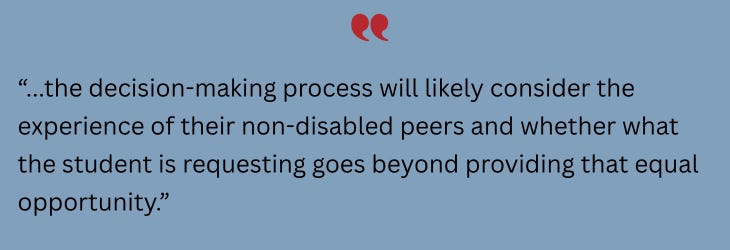
When students request accommodations, the decision-making process will likely consider the experience of their non-disabled peers and whether what the student is requesting goes beyond providing that equal opportunity. For instance, a parent in my group once asked whether their student’s college had to approve an accommodation for a professor to provide typed feedback on their work since the professor’s handwriting was illegible. The DS directors I consulted about this agreed with me that the professor’s handwriting affected all students, and the student in question didn’t have a visual disability that might have made the professor’s handwriting a relevant issue, so they didn’t see a need for an accommodation.* To learn more and see what they suggested (and why), read this post.
And a note here - I’ve heard from colleagues that some students’ high school IEP states that teachers can’t give them a failing grade, no matter how they perform in their class. This isn’t something colleges do.* (Also, neither IEPs nor 504 plans are valid at college.)
The specific requests
A study guide
The student presumably expected a professor or someone at DS to create the study guides for them. While I usually try to cite the parts of the law that tell colleges what they have to do (or don’t), I don’t think this directly falls under any of the exceptions the laws provide. (Read about these in Step 1 of my book.) Or it could be ruled out by the equal opportunity idea I just discussed.
But there’s something else to consider - the expectations colleges have for all students.
Section 504 says that colleges can’t discriminate against a “qualified handicapped person.” Down at §104.3 (l)(3), it further clarifies that the definition of this term means “[w]ith respect to postsecondary and vocational education services, a handicapped person who meets the academic and technical standards requisite to admission or participation in the recipient’s education program or activity.”
It is reasonable for colleges expect students to know how to prepare for tests, including making their own study guides, even if they have a disability. In my view, this would fall under the academic standards mentioned above in that definition of a qualified student.* This said, colleges may have tutors or academic coaches that help students make their own guides, though they’re not required to do so, or to provide any specialized help for that, such as someone who knows the content of the student’s specific class.
I understand that many students with disabilities have difficulty knowing what to study – their classmates without disabilities do, too. There is research showing that both groups of students report the same academic difficulties at college. In my opinion, a DS office’s analysis of a request like this would likely consider this first, and then stop.*
Instead, a DS office would likely suggest that the student do what this one had already done – meet with the professor and tutors. It appears that the student still wasn’t doing well. They might not fit that definition of “qualified,” and accommodations aren’t provided to change that.*
When questions like this come up in my professional community, all of the responses I see say they don’t approve such a request. (Remember the caveats above.) This isn’t an accommodation I’ve seen covered in the research, so I don’t have statistics to share showing how often this is approved (if ever).
Back-tracking on a test
If you’re not aware, at some colleges and in some programs, there are computerized exams where—once a student answers a question or skips it—they can’t track back to answer it or change the answer they already gave/chose.
While we’d like for students to use test-taking strategies they’ve learned (such as answering the questions they’re confident about first), this is something that would benefit all students. And again, when this has come up in my community, the responses I’ve seen say they don’t approve this. (Please see the caveats above again.) My colleagues who respond say they view this as a success-oriented accommodation rather than one that addresses a barrier that only affects students with disabilities. This student had extended test time, so they had the chance to use that to think about questions a bit longer before moving on.
Retaking tests
Hoping they would be approved for these additional accommodations, the student then wanted to re-take exams they’d taken without them. The laws don’t say this explicitly, but the way things work, accommodations don’t apply retroactively, meaning students don’t get do-overs if they’re approved for new, additional accommodations after completing an exam. Again, there’s no data on this, but I’ve never seen a colleague say they’ve approved this. Instead, they all say that accommodations apply only once they’ve been approved.
But a doctor put these recommendations in a letter…
Be aware that colleges aren’t required to do anything that doctors, neuropsychologists, or psychologists recommend. This is true whether recommendations are made in a letter or a lengthy report. And there are some other points to discuss here.
First – students have to follow DS’s process to formally request any accommodation they want. If they’ve already registered and been approved, they still may have to complete a form and even meet with their coordinator in order for the request to be reviewed.
Second - when they complete that form that asks what accommodations they are requesting, saying “please see my doctor’s letter” instead of specifying their requests is likely to result in delays. Many DS offices will send the form back to them and ask them to explicitly state what they want. Learn more here.
Also - doctors can’t request accommodations on students’ behalf. Putting them in a signed document on their letterhead doesn’t change that.
Keep in mind, too, that doctors’ mandate is to do/suggest what they think is best for their patient.* But there’s a good chance they don’t know what colleges are and aren’t required to do for students. (It seems the one in question didn’t, given the recommendations they made.) I’ve seen many psychologists and neuropsychologists recommend accommodations colleges aren’t required to provide, and their recommendation doesn’t change that.
Additionally (because this has been coming up recently in my community, especially around requests for single rooms and other accommodations) – accommodations don’t have to be approved just because they’re written into a student’s therapy plan.* That’s not part of this member’s question, but I wanted to mention it.
A message for those working with and/or parenting high school students
Having an adult provide study guides to high school students with disabilities is an example of where well-intentioned high school accommodations can leave students ill-prepared for college. While not every student plans to go to college, for those who do, high schools should teach them how to make their own guides and eventually fade out the adult-supplied one.
If your student will be a high school senior next year, it’s urgent that you address this with their case manager. If they’re younger, you have time, but don’t neglect to address this. Make sure there’s a plan for skill-building.
I’ve heard of K12 districts requiring teachers to provide study guides for all students, regardless of disability status. This means they’re poorly preparing their entire student body for college. (If this is happening where you work, you may want to speak to your administrators.)
Final thoughts
I know the thoroughness of the response here may make it seem like I’m being harsh. I am truly sorry to hear that the student is struggling. But I wanted to explain these issues fully, because it’s important for students, parents, and professionals to understand the purpose of accommodations and I wanted to provide some insight into how decisions get made.
I want to be clear – you won’t hear me say that students shouldn’t request a particular accommodation, and you shouldn’t interpret anything I’m saying as implying this. There are over 4000 colleges in the country – I don’t know what happens at each of them, obviously. I take my responsibility seriously in writing about these issues - hence the caveats I’ve laid out here.
My role here is to provide you with information to help you understand the possibilities and probabilities so you can use this knowledge to make sure your student(s) gets the best possible preparation for college. Too often, professionals and families assume what will happen there, resulting in students not being appropriately prepared for the changes there. I host my free Facebook group and spend my time responding to questions there and here to try to keep this from happening.
The best way to learn more about all of these issues is to read my book and/or watch my webinar that goes into detail about what accommodations are and aren’t commonly available is available on-demand. Once you pay, you can watch any time.
Have a question about what you’ve read? Comment below, join my group (where you can ask questions anonymously), or send me an email.
*Again - this post is for educational purposes only. It is not legal or medical advice and should not be construed as such. Please seek a qualified professional if you need such advice.
You can find lots of free content about preparing students with disabilities for college success on my main blog and YouTube channel. To learn much more, read Seven Steps to College Success: A Pathway for Students with Disabilities, watch my on-demand videos, read my concise 6-page guide, or hire me to speak to your school, group, or district.
.