College Students with Poor Class Attendance, Work Completion and/or Grades
What To Know Before the Term Ends ⌛

Have a college student who’s been very quiet about how school is going?
At the time I’m posting this, Thanksgiving is in a week, and many college students will be coming home for a brief time, and when they return to school, it will be only a week or two until classes end and finals begin. [Reading this at another time in the term, or in the spring semester? Keep reading. The earlier students act, the better their outcomes may be.]
Now is the time for parents who haven’t already done so to talk to their student about how they’re doing. If they tell you they haven’t looked at their grades all term, it’s probably even more urgent that they do so now. That kind of anxiety/avoidance likely means they know they’ve been doing poorly and they’ve been (understandably) reluctant to confirm that.
At this point in the term, there may not be very good options available to students who are doing poorly and/or have missed a lot of classes. I know that’s hard for them and you to face, but it’s important to find out what is possible now.
I’m writing about this this because I’m a college learning disabilities specialist who has years of experience trying to help students figure out how they’re going to complete a pile of overdue work. While I’m not involved in administrative matters, I know that every year students approach my colleagues who run disability services offices, hoping there’s a way they can save their grades.
Be aware that it’s not just students with disabilities who end up in these situations. If your student is what we call neurotypical but isn’t sharing much, this post may apply to them. That’s why the first part of it addresses the concerns the overall student population and the second half addresses questions parents of students with disabilities may have.
My goal here is to share some situations I’ve observed and to share how students may (or may not) be able to salvage them. I’ve chosen some random examples to illustrate university policies, but your student needs to know their own school’s policies.
And remember - this post does not provide legal or medical advice and shouldn’t be construed as such. If you need such assistance, please seek a qualified professional.
Let’s talk about a few scenarios 👆
1) Students Who Missed a Lot of Classes
Some parents are going to learn next week that their student has missed a number of classes (or in some cases, never attended them) without dropping the class before the deadline. They may hope to do so now.
If you’re reading this around Thanksgiving, it’s likely the drop deadline at your student’s school has passed, meaning they have to withdraw from any classes they’ve not been attending. On Temple University’s website, they do a good job of explaining the differences in terminology and also the consequences, including financial responsibilities and what notation appears on the transcript.
You may discover that your student never attended/stopped attending all of their classes. On a different page on Temple’s site, it says, “Students who stop attending all classes without officially withdrawing will be subject to a return of federal student aid funds at the end of the semester based on the last documented date of attendance as determined by Temple University.” (Again, this is not legal or medical advice, but I’m assuming policies look similar across all colleges because the federal government determines policies for funds it provides.) There may be additional consequences.
Your student should review their college’s withdrawal policy, and also make sure they understand what will appear on their transcript.
2) Students Who Attended Class Regularly But Didn’t Submit Assignments
Some students may have attended classes regularly but not submitted some/all of the work for one or more classes. They should email the professor(s) right away to see whether it’s possible to make it up. If they can still do some of it, help them make a plan for when the work will get done, and share your expectations that they will complete it all, even if it means sacrificing social and other activities they were looking forward to.
Students may hope to be granted an incomplete in one or more classes, which would allow them to make up missing work by a specific date (maybe before the start of the next term). At some schools, that won’t be approved unless a certain amount of the work is already done and the student earned a minimum set grade. For instance, The University of Arizona’s policy says “The grade of Incomplete (I ) may be awarded only at the end of a term when all but a minor portion of the course work has been satisfactorily completed and the student is unable to finish due to extenuating circumstances.”
If your student gets approved for an incomplete, make a plan with them now for when they will get the work done over break. It may even require canceling your family’s plans, or modifying them if someone will need to stay home to help keep your student on track to get the work done. You may consider hiring (at your student’s expense?) an executive functioning coach to keep them on track if you think working with you around this would be challenging.
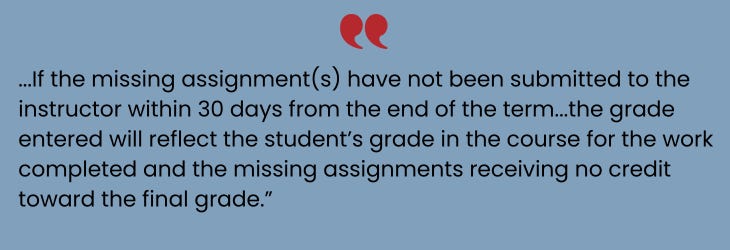
Incompletes typically have a set deadline and there are consequences for not meeting it. Northeastern University’s site says, “If the missing assignment(s) have not been submitted to the instructor within 30 days from the end of the term in which the course was offered, or the agreed upon due date, the grade entered will reflect the student’s grade in the course for the work completed and the missing assignments receiving no credit toward the final grade.”
Students should be aware of what will happen at their own college if they don’t meet the deadline.
3) Students who did poorly on tests/assignments
As with any of these situations, students should contact the professor(s) right away to see what they suggest and then they should do whatever they recommend. Professors might suggest attending all office hours and review sessions, seeking tutoring, etc. If students have a legitimate reason why they can’t attend scheduled office hours (e.g., a job or another class at the same time but not a weekly coffee with a friend), they should tell the professor about the conflict and ask if there’s any other way to connect with them.
Now is the time for students to reserve on-campus tutoring, support and writing center appointments if they’re arranged by appointments (rather than available on a drop-in basis). If they wait, all the slots may be gone by the time they try. Even if professors don’t suggest getting help, it’s a good idea for students who did poorly to seek assistance in understanding content they didn’t master earlier in the term that’s likely to be on the final.
Students can ask if they can earn extra credit or have a chance to retake tests or rewrite papers for a better grade, but they should be prepared for professors to say no. If so, they’ll need to make a plan to do everything they can to do well on whatever work is left and on upcoming tests.
Over their next school break, I can’t recommend highly enough that they read in full Outsmart Your Brain by Daniel Willingham. But even getting a copy now is helpful – it’s written to provide quick tips for studying. And they should check out his TikTok channel, where he also offers tips. (See the other experts I recommend to college students.)
In some cases, if they can’t pull their grade up, students will have to retake classes if they didn’t do well enough to meet a requirement for their major or just to receive credit for the class that they’ll need to graduate. Students should check their school’s policies, plus any policies for their major. For instance, a Psychology major might have to pass Statistics with at least a C to get credit toward their degree.
Does registering with disability services help in these situations? 👆
For students with disabilities who never registered with their university’s disability services office (DS), doing so now is a good idea (always). They should be aware that DS doesn’t have to rush its review process, so it’s possible this won’t be done before finals begin. However, if they’re approved, accommodations will be available to them in the next term. (Watch this or read this to learn how students get accommodations. Is your student resistant to registering? Here are some talking points you can use to convince them. Here’s a page to speak directly to them about it.)
[Students who did register may not have used their accommodations. They can begin at any time. They didn’t forfeit their rights by not using accommodations previously.]
Wondering how accommodations might have an influence in the above scenarios? Here are my thoughts. (Again, this isn’t legal or medical advice.)
Remember – accommodations are intended to “level the playing field,” but university policies are typically applied evenly to students with and without disabilities. They may show provide some flexibility, but colleges don’t have to completely disregard their policies just because a student has a disability.
1) Students Who Missed a Lot of Classes
Students who have already been approved for flexible attendance before now likely have a limit to how many classes they were able to miss and still receive credit for a class or have a chance to withdraw. If they exceeded those, they’re unlikely to have a different outcome than a neurotypical peer would have.
Those who haven’t registered before now and think they need accommodation for their missed classes are unlikely to get a different outcome, too. And even if they’re approved for some flexibility in their class attendance, that will start in the next term. It won’t be retroactive, meaning it doesn’t apply to the past classes missed.
2 ) Students Who Attended Class Regularly But Didn’t Submit Assignments
If students were approved before now for extended deadlines, they likely still had some deadline to meet. If they missed a lot of those, they may not get any further flexibility and may get zeros for the outstanding work. Professors aren’t required to keep extending deadlines unless there was an unpredictable emergency that kept the student from meeting the deadline they’ve already extended.
Those who haven’t registered yet should be aware that—while policies vary across colleges—a number of disability services offices don’t approve extended time to do work outside of class. Even when they do, it’s typically not a “blanket” accommodation where every time a paper is due, students get extra time. It’s usually a situation that when they have a severe, unpredictable flare-up of their mental health or physical/medical condition, they notify someone (policies vary) and then get a little extra time.
But even if they get approved now, it would still be a moot point for much of the work they’ve already missed, as accommodations aren’t retroactive. So it’s unlikely to help with grades for this term.
3) Students who did poorly on tests/assignments
It’s important to remember that Section 504 (which provides most of the guidance for colleges at Subpart E) includes in its section on prohibiting discrimination that “…aids, benefits, and services, to be equally effective, are not required to produce the identical result or level of achievement for handicapped and nonhandicapped persons, but must afford handicapped persons equal opportunity to obtain the same result, to gain the same benefit, or to reach the same level of achievement” [§ 104.4(b)(2)]
So if professors don’t give anyone a make-up exam, chance to rewrite something, or opportunities for extra credit, they don’t have to make an exception for students with disabilities.
As always, I never want someone to read my work and think I’m recommending they not try to register with DS or request an accommodation. With any request in any situation, their college might approve. My goal is to tell folks how things generally work and (hopefully) set realistic expectations. But I suggest your student reach out to DS no matter what the situation. It’s possible things things will work out.
I’m hoping that if you’re reading this and you’re concerned about your student, this is the first semester that this has happened. If your student is a freshman, perhaps they just aren’t ready for the full-on responsibilities of a traditional college environment right now. If they’re not new to college, has something changed? Are they depressed? Are they taking on more than they can handle? Think about why things are different than in previous terms.
Whether or not they get put on probation at their college as a result of what happened this term, it’s a good idea to spend their break talking to them about what they’ll do differently next term. Do they need to take fewer classes? Should they live at home (if possible) and commute so they can develop better personal care habits (sleep, nutrition) while managing academic demands? Do they need to make regular appointments at the tutoring center? Do they need to connect with a therapist? In my opinion, attending college is a privilege, and if you are paying, you should establish your expectations with your student.
If you are reading this after your student had a bad first semester, returned to school, and had another one, you may decide they need time off of school, even if the college will allow them to return. Clearly, something’s not working.
My friend and colleague Kelley Challen has excellent advice for what questions to ask and what to do while your student is taking time away from school. Read it here.
Caveats and further information
*This post is for educational purposes only. It is not legal or medical advice and should not be construed as such. Please seek a qualified professional if you need such advice. I’m sharing because I’ve worked in college disability services offices for more than 20 years and I’m active in my professional community.
You can find lots of free content about preparing students with disabilities for college success on my main blog and Youtube channel. To learn much more, read Seven Steps to College Success: A Pathway for Students with Disabilities, watch my on-demand videos, read my concise 6-page guide, or hire me to speak to your school, group, or district.